Friday, September 12, 2025

Read the pitch deck a 25-year-old startup founder used to raise $14 million for her friendship app

Alyx van der Vorm
Alyx van der Vorm is the 25-year-old CEO of Clyx.
  • Alyx van der Vorm launched Clyx to help people make plans with friends and meet new people.
  • Already live in Miami and London, Clyx is launching in New York and Brazil.
  • We got an exclusive look at the pitch deck Clyx used to raise its $14 million Series A.

Alyx van der Vorm, 25, wants to help young adults feel less lonely.

Her app Clyx lets people discover and attend events happening nearby with friends. It's one of several new social apps focused on in-real-life (IRL) experiences, rather than an online feed.

Like some other notable tech companies, van der Vorm said she first got the idea for Clyx in her Harvard University dorm room. Her friends were out of town, and van der Vorm didn't have plans. While she could instantly open up any app to order food or stream a movie, van der Vorm wanted a tool to instantly make a plan.

"It was just a matter of time until someone built something that could tell me, 'This is a yoga class your friend wants to go to, you should really go with her tonight,'" she told Business Insider.

Founded in 2020, van der Vorm first rolled out Clyx in Miami in 2022, then in London in 2023. The app has 50,000 active users joining events and about 200,000 looking at events, she said. Clyx is expanding the app to New York and São Paulo in September, with new features and fresh funding.

The startup recently raised a $14 million Series A round led by Blitzscaling Ventures. Other investors include author Simon Sinek, F1 racer-turned-VC Nico Rosberg, Venmo cofounder Iqram Magdon-Ismail, and early Facebook privacy exec Chris Kelly.

It plans to deploy its funding toward product, hiring engineers, and marketing, van der Vorm said.

The app makes money from a 2% cut of in-app ticket sales, paid boosts on in-app events, brand sponsorships, and selling tickets to Clyx-owned events.

Building an app for deeper friendships with AI

Joining other social startup peers, Clyx is leveraging AI to connect people.

Clyx uses AI to scrape events from across the web, and then turns those events into meetups in the app, van der Vorm said. If users have friends on the app, it will show if someone they know is going to the same event. It also has AI-powered tools to help match people with new connections at events where they may not have a friend already going.

While Clyx helps users meet people and find things to do, it also aims to help users be better friends.

"The problem isn't there aren't enough events, the problem isn't you don't have any friends at all," van der Vorm said. Making recurring plans can sometimes just feel … hard. Which is why van der Vorm thinks people need an extra "nudge."

"Our goal is to help people build and develop and grow their relationships through shared time," van der Vorm said, and that comes through repetition, she added.

Clyx also has plans to expand beyond friendship. It's launching a dating app in Brazil to put its matchmaking to the test.

"Our most valuable tech is our matchmaking AI," van der Vorm said. "Our ability to say, this is the person you get on with and this is the thing you'd enjoy with them."

Read the pitch deck Clyx used to raise its $14 million Series A:

Note: Clyx redacted slides and details in order to share its deck publicly.

Clyx starts with its tag line
Clyx: a life lived with genuine friendships
"Why is it easier to order a taxi or take out than it is to meet likeminded people near me?" It turns out Alyx wasn't the only one struggling to find things to do and friends to do them with in her new home…
Then the deck shares its founder's story
"Why is it easier to order a taxi or take out than it is to meet likeminded people near me?" It turns out Alyx wasn't the only one struggling to find things to do and friends to do them with in her new home…

"Why is it easier to order a taxi or take out than it is to meet likeminded people near me?" the slide says.

"It turns out Alyx wasn't the only one struggling to find things to do and friends to do them with in her new home…" the slide says.

Then it outlines the problem: loneliness
Loneliness is at record highs, as per Harvard Study of Adult Development. This has a direct impact on mental and physical health. With remote work on the rise, Gen Z lack tools to build local community & IRL social lives. 36% Total respondents identify as "seriously lonely" 61% 18—24 yrs "seriously lonely" 50% Locked Communities report less friends Young Women Most Likely to Report Losing Touch with Friends During the Pandemic % of people who said how much contact or how maintained it with friends over the past 12 months.

Here's what the slide says:

The Problem

Loneliness is at a record high, as per Harvard Study of Adult Development. This has a direct impact on mental and physical health. With remote work on the rise, Gen Z lack tools to build local community & IRL social lives.

36%: Total respondents seriously lonely

61%: 18-29 Yr Olds seriously lonely

50%: Lacked Connection in past 3 weeks

The slide then includes charts about how the pandemic impacted people's contact with their friends. It says that young women were most likely to report losing touch with their friends during the pandemic.

The slide also includes the following quote from former US Surgeon General Dr. Vivek H. Murthy:

"The mortality impact of being socially disconnected is similar to that caused by smoking up to 15 cigarettes a day."

Clyx opines on what's caused this loneliness
The world is more physically, culturally and technologically connected than ever. However, the hyper-connectivity associated with Globalisation comes at the cost of social connectivity and genuine connections. Trends in Globalisation move us away from our tribal traditions of putting roots down, and pushes us towards one of hyper mobility and technologically centric relationships. COVID-19 pandemic deepened reliance on technology, promoted "mobile" lifestyles, and accelerated isolation.

Here's what the slide says:

Globalisation & Remote work

The world is more physically, culturally and technologically connected than ever.

However, the hyper-connectivity associated with Globalisation comes at the cost of social connectivity and genuine connection. Trends in Globalisation move us away from our tribal traditions of putting roots down, and pushes us towards one of hyper mobility and technologically centric relationships.

The COVID-19 pandemic, a function of our seemingly shrinking global society, deepened our reliance on technology for social connection and further promoted the 'mobile' and somewhat nomadic lifestyles that go hand in hand with Globalisation.

Besides the obvious social distancing measures put in place across the world, the Pandemic deepened our ability to live a socially secluded yet virtually connected life. Working from home has become the norm and zooms with family and friends have replaced in person meet ups.

It almost seems counterintuitive but Globalisation and the way it has changed society, coupled with the COVID-19 pandemic have created the perfect storm for loneliness to proliferate.

It also addresses social media's role
social media

Here's what the slide says:

Social Media

While there is no doubt that traditional social media can in some cases benefit those that are lonely, more often than not social media exacerbates the loneliness problem.

Why? Because Instagram, Snapchat, Facebook and other incumbent social media platforms are focused on voyeurism and digital connection, rather than deep and substantive relationships. One is looking at the past experiences of others, rather than creating your own future experiences.

Scrolling through the flood of images of people delighting with their friends can hound lonely people with feelings of deficiency and shame — deepening feelings of being unwanted and magnifying people's longing for real understanding and connection. More importantly, existing platforms rarely give those that are lonely the tools to exit their spiral of virtual self-loathing.

Again, there is no doubt that our reliance on social media increased exponentially during COVID-19, compounding the issues fundamental to the current social media offering.

Clyx then dives into its founder's college experience at Harvard
Clyx was founded at Harvard In response both to Alyx's personal experience and the wider loneliness epidemic.

"Clyx was founded at Harvard," the slide says. "In response both to Alyx's personal experience and the wider loneliness epidemic."

Then the deck explains why Clyx is a solution
solution

Here's what the slide says:

Clyx tells users which local events their friends and communities want to do.

1. Recommend real life events

Clyx uses AI to aggregate all the events happening in a city — yoga classes, concerts, gallery openings.

2. Suggest new friendships

Clyx fosters an environment full of people looking to spend time together IRL. Whether users find an event or create it, they feel comfortable knowing it's in a space of people with similar values.

3. Empower local communities

Clyx users find communities that grow to play a meaningful role in their lives. Groups reduce social pressure, improve safety, and boost the collective energy of the event.

It shows some product imagery
how clyx works

The app looks a little different now, however.

It includes examples of how the product works
the product

Some of this has changed since the deck's creation.

Then the deck digs into Clyx's traction
industry leading retention metrics

Here's what the slide says:

Industry Leading Retention Metrics

One of our biggest successes is our user retention in both Miami and London — it reflects the usability, quality, necessity and trust in both the product and brand we have built in the US and UK.

When compared to the incumbent industry leaders the difference is stark. Tinder and Bumble's combined avg. D30 retention is less than a fifth of Clyx's.

Why? Our focus on in-person meet ups, friendship and speed of connection means that Clyx users come for friends and stay for the events. Coupled with the quality of content in-app, this puts Clyx at the sharp end of industry retention. The more friends users add and communities they join, the more likely they are to keep engaging with Clyx frequently.

Notably, users that engage in the simplest of in-app actions retain even better than our base case.

The deck includes lots of graphs
strong acquisition track record
It also goes into detail about specific cities where the app has launched, like Miami
miami

"We beta launched Clyx in Miami in 2022 as the official app of Miami Tech Month," the slide says. "Since our launch we have developed a strong and fiercely loyal user base. We continue to see rapid growth in the city as Clyx users grow new communities and local event hosts flock to Clyx to find their audience."

It launched in London in 2023
london

"We launched in London in the summer of 2023. Since our launch, we have once again fostered a large group of loyal users located around the city — both students at colleges and young professionals," the slide says. "We grew even faster in London as we learned many growth hacks — such as starting with key flagship events that trend virally, such as 'Hot Girl Walk' and 'Hot Girl Wine Night.'"

The deck breaks down some data points about Clyx outcomes
measureable outcomes

Here's what the slide says:

Measurable Outcomes

  • 462,030 Friendships Made: We foster meaningful connections grounded in compassion, honesty, and empathy.
  • 140,713 Events Organised: Embracing the freedom to be myself with those who genuinely understand me.
  • 92 Feel Noticeably Happier With Clyx: A survey of our users found that 92% of those who use Clyx were happier with our platform than they were without it.
Then it dives into monetization strategies
advertising

Here's what the slide says:

Our reach, demographic and architecture make Clyx the perfect place for brands and venues to advertise:

Ads are aligned with Clyx's mission

Users are looking for activities and venues to visit; venues are looking for relevant customers. We connect their mutual interests; higher conversion. More similar to Amazon (market place) than Facebook (unrelated adverts).

Friends operate as Micro-Influencers

When a friend joins an advertised event, you are far more likely to want attend that event/venue. As more friends join, this desire to attend only grows and so helps to boost conversion rate for promoted events.

Suggestions informed by our algorithm

We know a lot about our users; their interests, location, propensity to travel, friends activity and more. This allows our algorithm to accurately suggest events to even the best versed organisers.

It includes examples of partnerships
sony x clyx

Here's what the slide says:

Sony X Clyx

  • June 2024 Sony contacted Clyx asking for help marketing the premiere of their new film Fly Me To The Moon; Sony wanted to augment their VIP advanced screening in Miami & allocated part of their marketing budget to Clyx.
  • Clyx promoted the event in-app and we were SONY's best performing distributer.
  • We are now discussing a broader partnership to promote all releases
Clyx partnered with a wine bar in Miami
lagniappe advertising

Here's what the slide says:

Lagniappe: 3 months advertising on Clyx

699 Event Joins

24 Events promoted

Lagniappe, a Miami Wine bar, leveraged our mostly female user base to rapidly grow attendance on Wednesday's when footfall was typically at its lowest.

Encouraged by the success of their bi-weekly events, Lagniappe now regularly advertise on Clyx. Leveraging the power of our audience; newsletter and app.

It monetized with in-app purchases
in-app purchases

Here's what the slide says:

In-app purchases on Clyx look to monetise actions that are crucial to our ecosystem for creators and more casual users alike.

Namely, during beta testing, Clyx has sought to monetise event creation, community membership and profile visibility.

The fear of missing out and desire to be part of something ensures that prospective community members, event joiners and new users are willing to pay for access and extra visibility. To date Clyx has introduced in-app purchases for:

  • Event Promotion — event creators are able to purchase event boosts, which help their event stand out from the crowd.
  • Profile Visibility — upon the creation of their profile, users are promoted to boost their profile in our proprietary algorithm. Increasing the speed at which they make friends early on in their Clyx experience.
  • Community Joins — in order to join certain exclusive communities users are required to make an in-app purchase.
It also made money through ticketing
ticketing

Here's what the slide says:

There are a variety of events on Clyx which operate at different scales — some are casual hangouts in the park or coffee meet ups, but others are larger events that hosts want to ticket. Clyx's product and user community makes it the perfect place for hosts to sell tickets. Why?

Events & Hosts Users Can Trust

Without knowing much about the event host and others going, it can be intimidating to spend on ticketed events. The social element fundamental to Clyx helps to alleviate this purchase anxiety and boosts sales for hosts and in turn revenue for Clyx. If you can see friends are going, you are more likely to buy.

Simple Setup

It takes hosts on average less than a minute to ticket their event on Clyx. They have to create or connect an existing Stripe account to their Clyx profile and set their desired price. We then payout their revenue (minus fees) daily.

End-to-End

Unlike Eventbrite and other ticketing platforms, the user journey isn't over once they have pressed 'buy'. Having purchased a ticket, those going can get to know other fellow attendees before the event takes place, improving their experience on the day and the likelihood of repeat purchases.

The deck concludes by introducing the team
theh team

Here's what the slide says:

  • Alyx van der Vorm, Founder, CEO

    Double John Harvard scholar, Computational Neuroscience. With a passion for running marathons & dislike for the hassle of organising meet-ups.

  • Ed Beccle, Product Strategy

    4x Founder (2x exit). App Glorify reached >3mil users in <2 years, backed by A16Z. Understands consumer social & product-led growth.

  • Francesco Rapacciuolo, Head of Design

    Former Head of Design at Bumble. Peached due to his experience building friendship products. Previously Head of Design at Musixmatch before exit to Spotify.

  • Mike McIntyre, Growth Strategy

    First Product Manager at Instagram. Formerly at Meta. Exited his consumer app Fam after reaching 10M MAU and profitability. Loves running growth experiments & hacks.

  • Berk Karaoglu, Engineering

    Ex-Getir database and cohorting specialist with deep experience in consumer apps. Loves making things go faster and making sure we're built for scale.

It also introduces some of its investors
tech investors

It lists the following investors:

  • Jack Einhorn
  • Peter Dubens
  • Francois Reyl
  • Matthew Rayes
  • Calvin Chan
  • Paul Bottino
It ends with its tag line again
clyx
Read the original article on Business Insider


from Business Insider https://ift.tt/Vl0y35c
I was called back into the JPMorgan office. My family has had to adjust, but I trust the company.

a man posing near the ocean
Jitender Jain.
  • Jitender Jain transitioned to a hybrid role at JPMorgan Chase after Walmart's office closure.
  • He goes to the office three days a week, and he and his wife navigate parenting and cleaning accordingly.
  • Jain values in-person work for stronger connections and broader economic contributions.

This as-told-to essay is based on a conversation with Jitender Jain, a 40-year-old principal software engineer at JPMorgan Chase and a father of two daughters in Dallas. The following has been edited for length and clarity.

Last year, when I worked at Walmart Global Tech, the company suddenly announced it was closing its Dallas office. I was told I'd have to relocate to another state and return to the office full time.

I wasn't ready to transition from working from home to moving to a new state and going to the office daily, so I took severance from Walmart and transitioned to a hybrid role as a principal software engineer at JPMorgan Chase. A colleague referred me for the position, and after multiple rounds of interviews, I accepted the offer.

Around the same time, my wife's team was called back to the office three days a week and was reduced from nine to just three engineers, tripling her workload. Life throws curveballs, but after navigating COVID-19, we felt equipped to handle the transition together.

With some thoughtful planning around childcare, we were able to manage, though there were challenges, and we're still getting used to it.

I work three days in the office and two from home

Two days are fixed team days we agreed on together, and the third is flexible. I go to the office on Monday, Tuesday, and Thursday. Many JPMorgan employees have been called back to the office five days a week. My commute is only about 15-20 minutes each way, which is manageable.

I know others have it harder. There are people who bought homes farther away during the pandemic because of cost or space. I remember leadership saying early on, "We won't be remote forever," and I took that seriously.

Truth be told, working from home during COVID-19 and even after wasn't exactly enjoyable

When we were all remote, my wife and I would sometimes both have meetings at the same time, so we'd each have to close our doors and hope for the best.

Meanwhile, our daughters, 8 and 13, would be playing outside the rooms, and that play would eventually turn into a quarrel over the same toy or game. That's when I'd have to jump in and help. I would rather be at the office.

We send the kids to school and then to aftercare. In the summer, they attended day camps. My wife and I coordinate pickup and drop-off.

I learned to share household responsibilities during the pandemic

I started doing things like cooking and doing the dishes. To be honest, I was forced into it at first, but over time, I've gotten used to it so that now, when a child is sick or has an appointment, my wife and I trade off based on our schedules. It's helping everyone — not just my wife but the whole family — because we're all happier when she gets more time to follow her passions.

When we were all at home, most of the work and meals happened in the house, so there were a lot more chores. Now that we're out during the day, we all eat lunch outside, so there's much less to do at home. We're more relaxed, we eat dinner as a family, and the kids fight less often.

There's a lot of flexibility at my company

It's no problem if someone needs to shift a meeting, take a kid to the doctor, or attend remotely.

I got used to sitting in the comfort of my home with my family, but in-person work gives us an edge. You build stronger connections, solve problems faster, and create better solutions. Newer employees, especially, benefit from in-person support and mentorship. That's part of my responsibility, too.

Working on-site also contributes to the bigger picture: If I go to the office, I generate revenue. Vacant buildings are rented again. They employ security guards. I spend money at restaurants and other local businesses. I try to think beyond just what's convenient for me. I trust the company has a better view of the big picture than I do.

Eventually, we will be called back into the office five days a week. It will return to the way it was pre-COVID-19, and it may be a challenge at first, but we'll adapt.

Read the original article on Business Insider


from Business Insider https://ift.tt/I8au2y5

A Goldman Sachs chief investment officer shared the 3 sectors he's most excited about

darren cohen, goldman sachs
Darren Cohen, chief investment officer and cohead of Goldman Sachs' growth equity team, said he's particularly fond of SaaS businesses.
  • Goldman Sachs' Darren Cohen highlighted AI, fintech, and healthtech as his top sectors for investing.
  • He told the bank's "The Markets" podcast that AI would have a "huge transformative effect on the world."
  • Cohen thought innovation in healthcare tech has moved incredibly quickly since COVID-19.

A chief investment officer at Goldman Sachs listed his top three sectors for investing.

In a recent episode of the bank's podcast "The Markets", Darren Cohen, cohead of the investment bank's growth equity team, said which sectors he thought presented the best opportunities.

1. AI

Cohen said Software-as-a-Service companies weren't "dead."

"I think we're seeing amazing SaaS businesses absorb AI at a speed at which they're going to have a real competitive advantage as they bring those solutions to market," he added.

The partner at Goldman said that he feels these evolutions will eventually unlock more value for his team's legacy portfolio.

Cohen added he was also excited about how AI was changing the way we trade.

"It's pretty game-changing and then ultimately it's gonna have this huge transformative effect on the world, so it's hard to look at anything that could trump that," he said.

2. Fintech

Alternative investments — hedge funds, real estate, private equity, and private debt — are another investment opportunity, he said, because they will soon undergo digital transformation.

"There's one asset class in the world that hasn't gone through a digital transformation, and that's alternatives," Cohen said, adding that this would probably take about a decade.

3. Healthtech

Cohen said historically, healthtech wasn't a sector that Goldman invested much in, but there had been a "seismic shift" in "how healthcare is absorbing innovation" since the COVID-19 pandemic.

"We also love it because it's a complicated, very messy ecosystem," he said.

Read the original article on Business Insider


from Business Insider https://ift.tt/8R4GDIs

Thursday, September 11, 2025

Photos show Charlie Kirk's rise from a young conservative upstart to a powerful member of Trump's inner circle

Charlie Kirk onstage with Donald Trump at America Fest 2024.
US right-wing activist Charlie Kirk (R) speaks on stage with President Donald Trump at America Fest 2024 in Phoenix, Arizona, on December 22, 2024. Right-wing youth activist and influencer Charlie Kirk, a major ally of President Donald Trump, was shot dead on September 10, 2025 in a murder that sparked fears of more political violence in an increasingly febrile United States. Trump confirmed on social media that Kirk, 31, had died from his injuries.
  • Right-wing activist and influencer Charlie Kirk was shot and killed on Wednesday.
  • Kirk cofounded Turning Point USA, which grew rapidly as he gained a massive social media following.
  • Trump ordered flags to be flown at half-mast following Kirk's death at age 31.

In just a few short years, Charlie Kirk went from an unknown high school student to one of the most influential conservative voices in America.

His meteoric ascent was cut short when he was shot and killed on the first stop of his "American Comeback Tour" at Utah Valley University on Wednesday. He was 31.

Kirk first rose to fame as a high school senior in April 2012, when he authored an op-ed for Breitbart titled "Liberal Bias Starts in High School Economics Textbooks." The article caught the attention of Fox & Friends, where he appeared as an on-air guest.

Kirk then met businessman Bill Montgomery at a Youth Government Day event at Benedictine University in May 2012, and Montgomery urged him to drop out of college and continue to organize young conservatives after hearing him speak. Together, they founded Turning Point USA that same year.

The organization expanded rapidly as Kirk grew a massive social media following, often posting clips of himself debating college students, academics, and other figures from across the political spectrum. Turning Points USA now has chapters on over 3,500 college campuses and reported $85 million in revenue in 2024.

His success as a firebrand communicator, effective fundraiser, and political organizer among young voters cemented him as a member of President Donald Trump's inner circle — despite, or perhaps because of, his polarizing rhetoric, which often drew protests at speaking engagements.

Photos show Kirk's rise from a young conservative upstart to a powerful member of Trump's inner circle.

At age 22, Charlie Kirk was the youngest speaker at the 2016 Republican National Convention.
Charlie Kirk speaks at the 2016 RNC.
CLEVELAND, OH - JULY 18: Charlie Kirk, Founder and Exec. Dir. of Turning Point USA, speaks on the first day of the Republican National Convention on July 18, 2016 at the Quicken Loans Arena in Cleveland, Ohio. An estimated 50,000 people are expected in Cleveland, including hundreds of protesters and members of the media. The four-day Republican National Convention kicks off on July 18.

Shortly after the convention, Kirk spent three months working as Donald Trump Jr.'s social media coordinator and scheduler.

"I was pretty reluctant to bring on another so-called campaign expert, especially when I learned how young he was," Trump Jr. told The New York Times in February. "I said, 'We don't need another person who doesn't know anything — we've already got plenty of those.' But within five minutes of listening to him, I said, 'Congratulations, you're on my team.'"

Kirk's influence grew as he amassed a large online following through viral videos of him debating political and ideological opponents.
Charlie Kirk and Hasan Piker debate at Politicon.
PASADENA, CA - JULY 29: (L-R) Moderator Steven Olikara, Charlie Kirk, and Hasan Piker at 'Turning Point USA Presents: Charlie Kirk vs. Hasan Piker' panel during Politicon at Pasadena Convention Center on July 29, 2017 in Pasadena, California.

In 2017, Kirk debated left-wing political commentator and YouTuber Hasan Piker at Politicon.

The two figures, who often faced off, were scheduled to debate once again at Dartmouth College later in September. Piker called Kirk's shooting a "terrifying incident."

When Trump was elected to his first term, Kirk became a frequent guest at the White House.
Charlie Kirk and Candace Owens at the White House
WASHINGTON, DC - JANUARY 2 : Charlie Kirk and Candace Owens from Turning Point USA, listen as President Donald J. Trump speaks during the 2018 Young Black Leadership Summit in the East Room of the White House on Friday, Oct. 26, 2018 in Washington, DC.

Kirk told The New York Times in February that he visited the White House over 100 times during Trump's first term.

On one of those visits, he joined Candace Owens at the 2018 Young Black Leadership Summit held in the East Room of the White House.

Kirk interviewed Trump at the Generation Next Summit, an event geared toward conservative millennial leaders, at the White House in 2018.
President Donald Trump shakes hands with conservative activist Charlie Kirk at a forum dubbed the Generation Next Summit at the White House on March 22, 2018.

In a wide-ranging interview, Kirk asked Trump about the job market, the opioid crisis, and free speech.

In 2019, Kirk founded Turning Point Action, a political action organization.
President Donald Trump is joined on stage with Turning Point USA Founder Charlie Kirk as he finishes speaking at Turning Point USA Teen Student Action Summit at the Marriott Marquis in Washington, Tuesday, July 23, 2019. (AP Photo/Andrew Harnik)

Turning Point Action launched initiatives such as Students for Trump, which hosted Super Saturday events across the country where college students knocked on doors and registered voters ahead of the 2020 election.

He addressed the 2020 Republican National Convention, which was held virtually due to the COVID-19 pandemic.
Charlie Kirk speaks at the 2020 virtual Republican National Convention.
CHARLOTTE, NC - AUGUST 24: (EDITORIAL USE ONLY) In this screenshot from the RNC's livestream of the 2020 Republican National Convention, Charlie Kirk, founder of Turning Point USA, addresses the virtual convention on August 24, 2020. The convention is being held virtually due to the coronavirus pandemic but will include speeches from various locations including Charlotte, North Carolina and Washington, DC.

In his speech, Kirk referred to Trump as "the bodyguard of Western civilization."

"I am here tonight to tell you, to warn you, that this election is a decision between preserving America as we know it and eliminating everything that we love," he said.

Kirk also launched his podcast, "The Charlie Kirk Show," in October 2020.

Kirk remained loyal to Trump after the January 6 insurrection.
Charlie Kirk speaks at the Turning Point Action conference.
WEST PALM BEACH, FLORIDA - JULY 15: Founder and executive director of Turning Point USA Charlie Kirk speaks at the opening of the Turning Point Action conference on July 15, 2023 in West Palm Beach, Florida. Former President Donald Trump is scheduled to speak at the event held in the Palm Beach County Convention Center.

As other members of the Republican Party distanced themselves from Trump following the Capitol riot, Kirk made a point of visiting Trump at Mar-a-Lago in February 2021.

In May 2021, Kirk married Erika Frantzve, a former Miss Arizona USA winner and entrepreneur.
Charlie Kirk and his wife, Erika Kirk, at the Turning Point USA inaugural ball.
WASHINGTON, DC - JANUARY 19: Charlie Kirk (L) and and his wife Erika Lane Frantzve (C) watch as The Village People perform on stage during the Turning Point USA Inaugural-Eve Ball at the Salamander Hotel on January 19, 2025 in Washington, DC.

Frantzve, 36, played NCAA women's basketball at Regis University. She then transferred to Arizona State University, where she double majored in political science and international relations, according to her official website. She earned a master's degree in American legal studies from Liberty University and remains enrolled there as a doctoral student in Bible studies.

She was named Miss Arizona USA in 2012.

Frantzve runs a Bible study and ministry program, BIBLEin365, and a clothing line, PROCLAIM, with designs featuring Bible verses and references. She also hosts a devotional podcast, "Midweek Rise Up."

She and Kirk met in 2018 and got engaged in 2020. The couple shared two young children, whose names and faces they did not publicize.

Kirk supported JD Vance's Senate campaign in 2022 and advocated for him to be chosen as Trump's running mate in 2024.
Charlie Kirk, JD Vance, and Josh Hawley.
CUYAHOGA FALLS, OH - MAY 1: (L-R) Conservative activist Charlie Kirk, J.D. Vance, a Republican candidate for U.S. Senate in Ohio, and Sen. Josh Hawley (R-MO) speak with reporters at a campaign rally on May 1, 2022 in Cuyahoga Falls, Ohio. Former President Donald Trump recently endorsed J.D. Vance in the Ohio Republican Senate primary, bolstering his profile heading into the May 3 primary election. Other candidates in the Republican Senate primary field include Josh Mandel, Mike Gibbons, Jane Timken, Matt Dolan and Mark Pukita.

Kirk joined Vance and Sen. Josh Hawley at Vance's Senate campaign rally in Cuyahoga Falls, Ohio, in May 2022.

Kirk played a key role in Trump's 2024 campaign through frequent public appearances and Turning Point USA's Chase the Vote initiative to mobilize voters.
Charlie Kirk at the 2024 Republican National Convention.
MILWAUKEE, WISCONSIN: JULY 15: Charlie Kirk, founder and executive director of Turning Point USA, speaks during the Republican National Convention (RNC) at the Fiserv Forum in Milwaukee, Wisconsin, US, on Monday, July 15, 2024.

Kirk also spoke at the 2024 Republican National Convention.

"To all the Gen Zers watching this convention on TikTok right now, I have a message just for you," he said. "You don't have to stay poor. You don't have to accept being worse off than your parents. You don't have to feel aimless and unhappy. You don't have to support leaders who lied to you and took advantage of you for your vote. America's future is a series of choices."

Turning Point USA held a ball on the eve of Trump's second inauguration in January, where Kirk joined Vance and Donald Trump Jr. onstage.
Charlie Kirk at the Turning Point USA inaugural ball.
WASHINGTON, DC - JANUARY 19: (from left to right) Alina Habba, Senior Advisor to President Donald J. Trump, Sergio Gor, Donald Trump Jr., U.S. Vice President-elect JD Vance, Charlie Kirk, and Kid Rock on stage with The Village People during the Turning Point USA Inaugural-Eve Ball at the Salamander Hotel on January 19, 2025 in Washington, DC.

In his remarks at the event, Trump Jr. called Kirk "one of the true rock stars of this movement."

On September 10, Kirk was shot and killed on the first stop of his "American Comeback Tour."
Charlie Kirk at Utah Valley University, where he was shot and killed.
OREM, UTAH - SEPTEMBER 10: Charlie Kirk appears at Utah Valley University on September 10, 2025 in Orem, Utah. Kirk, founder of Turning Point USA, was speaking at his "American Comeback Tour" when he was shot in the neck and killed.

Kirk was shot in the neck while sitting under his trademark "Prove Me Wrong" tent and taking questions from the crowd at Utah Valley University in Orem, Utah.

Utah Gov. Spencer Cox called Kirk's death a "political assassination."

Following the announcement of Kirk's death, Trump ordered flags to be flown at half-mast, a tribute normally reserved for the deaths of elected officials or cabinet members.
Flags at half-mast after Charlie Kirk's death.
WASHINGTON, DC - SEPTEMBER 10: The American flags near the White House on the North Lawn fly at half staff following the death of Turning Point USA founder and conservative activist Charlie Kirk on September 10, 2025 in Washington, DC. Kirk was shot and killed while speaking at Utah Valley University earlier today.

"The Great, and even Legendary, Charlie Kirk, is dead," Trump wrote on Truth Social. "No one understood or had the Heart of the Youth in the United States of America better than Charlie."

Read the original article on Business Insider


from Business Insider https://ift.tt/oaC27zf

Wednesday, September 10, 2025

We moved into a tiny house in a small Wyoming town. It was dreamy at first, but we just feel stuck 5 years later.

Author Amber McDaniel sitting on steps of tiny home
There are perks of living in a tiny home, but it's not as great as I hoped it'd be.
  • We were living the van-life dream until pandemic-related shutdowns made it a nightmare in 2020.
  • Out of desperation, we impulsively bought a tiny house in a rural town we'd only just arrived in.
  • You'd think living tiny would make it easier to leave. But the reality is, we're stuck years later.

In 2020, when the world was locking down, my partner and I were living full-time in our self-converted camper van, chasing fresh air and freedom.

But as COVID-19-related closures swept the nation, that freedom dried up almost overnight.

Campgrounds shut down. Laundromats became off-limits. Gyms we relied on for weekly showers locked their doors. When people took one look at our out-of-state plates, they offered nothing but scornful looks.

Practically overnight, van life became entirely unsustainable, and we went from wholeheartedly embracing the motto "home is where you roam" to the concept of "home" feeling fragile and elusive.

We needed somewhere to land — fast. But we never expected that search would lead us to a tiny town in Wyoming, or that we'd still be stuck there five years later.

At first, it felt great to upgrade from a van to a tiny home in a small town

Tiny home with blue railings
We own a tiny home and rent the land that it's placed on.

We always intended to make somewhere in the Mountain West our home.

I grew up in Montana, and my partner, who's from the very different world of suburban Philadelphia, fell in love with the wide open spaces I'd grown up taking for granted.

However, we never imagined we'd put down roots during a quick stop in Wyoming to meet up with a friend of a friend to go rock climbing.

Before this visit, we'd never even been to the small town we ended up in. However, when we found a tiny house for sale on a rented lot in a mobile-home park here, we knew it might be our only shot to put down roots.

The housing prices in the Mountain West had already started to skyrocket — homes in areas where I grew up were suddenly selling for three to four times what they had just a year earlier.

We didn't have the luxury of waiting or saving, and we certainly didn't want to go back to renting.

The tiny house wasn't perfect, but it was relatively affordable. And even though we'd still be renting the land, owning the home itself at least meant building equity.

Two weeks later, we signed the paperwork and said hello to the first actual home we'd ever owned.

Small wood railing loft area above living area in tiny home
Our small home felt like an upgrade from our camper van.

In the beginning, our jump from 40 square feet to 400 felt downright luxurious. We had a real shower, a full-size fridge, and a toilet we didn't have to dump out on our own.

We reveled in having a designated couch that was not also the bed and enough space to work out indoors when the Wyoming wind howled outside.

We already knew how to live with less, so transitioning was easy.

However, as time passed, so did the phase where living tiny felt novel

Kitchen inside tiny home
We finally had a full-sized fridge in our tiny home.

Over the next few years, we opened several small businesses, and eventually ended up running a full-time upcycled crafting business out of the house. This meant an influx of raw materials, tools, shipping supplies, and finished inventory.

Suddenly, every corner of our home was bursting with stuff. What had once felt spacious now felt claustrophobic. Soon, we felt trapped living tiny.

Clutter on floor of tiny home
Running a business out of our home has been challenging and overwhelming.

Unfortunately, we've run into a lot of issues while trying to improve our situation.

We rent the lot our home is on, so we can't just expand our house's structure. Though we'd purchased the home with the intent to move it onto our own plot of land so we could build a garage or outpost buildings, that, too, has proven to be far more complicated than we expected.

The house exists on a trailer for a foundation, but it's big enough that it requires a semi-chassis (a type of support frame) to move. But even if we did coordinate a move, we don't have a place to go.

With so many local HOA restrictions and prohibitions on manufactured homes, it's become apparent that most nearby neighborhoods and counties don't want our tiny house, either.

In an inflated housing market, trying to buy a bigger home also feels impossible. We've browsed every listing within a five-state radius — beyond, when we start to feel extra desperate.

We haven't found a decent option we can afford without landing in a hole of debt so deep that we realistically would never be able to climb out.

For now, we're trying to make the most of the life we have

Author Amber McDaniel sitting inside tiny home on steps
Tiny living isn't exactly what we expected.

We chose this tiny house because it was the best of our very limited options. At the time, it felt like the only open door available — but it's now locked itself behind us.

Though we have carved out a small support circle in this tiny town, its isolation still feels heavy. We're a full day's drive away from any close friends or family to speak of, so those wide open spaces we value have ironically become a cage in their own right.

We still believe in living simply, and so we're making the best of it as we remain hopeful for more.

To give ourselves breathing room, we travel as often as we can — usually in our trusty camper van, which faithfully waits for the next adventure in our garageless gravel driveway.

We've also been working on adjusting and organizing our home so it's more efficient to live in and has as much storage space as possible.

It's so easy to romanticize the trend of tiny living when you're watching it on your TV, but sometimes, it feels like we were sold a dream that didn't account for how life changes.

Our lives got bigger, while our home couldn't grow to match.

Read the original article on Business Insider


from Business Insider https://ift.tt/Oka6SJZ

The CEO of Booking Holdings once got laid off. He shares the two things he learned from the experience.

Glenn Fogel
Glenn Fogel is the CEO of Booking Holdings, the parent company of 11 travel brands.
  • Glenn Fogel, CEO of Booking Holdings, recounts being laid off from a banking role early in his career.
  • He said the layoff taught him to reassess what he wanted to do and what he valued.
  • Fogel said the experience also taught him how to approach laying off others.

CEO of Booking Holdings Glenn Fogel sits at the helm of 11 travel brands, including Booking.com, KAYAK, OpenTable, and Priceline. But three decades ago, he was in a very different position — laid off from a corporate job and unsure about what was next.

After earning an MBA from Wharton and a law degree from Harvard, Fogel worked in investment banking at Kidder, Peabody & Co. He told Business Insider that when the firm merged with Paine Webber, many bankers were cut. What struck him, though, was that some of his colleagues were retained when he wasn't — a detail he said shaped how he viewed the situation.

"Are you not good? Are you just in the wrong department in investment banking? Or, are you just too expensive?" Fogel said, recounting the questions that lingered in his mind.

Fogel, who has now been CEO at Booking Holdings for eight years, said that losing your job can be "extremely traumatic. " However, the experience ended up being one of the defining moments of his career, he said, and taught him two critical lessons.

Treat others respectfully

Fogel said the way he was let go felt like a scene out of a Wall Street movie. He was brought into a room with an HR representative, thanked for his work, and presented with a document promising not to speak negatively about the firm in exchange for a severance package. After signing, he was escorted from the building.

"'You will not go back to your desk to get your clothes, or if you had a coat, it will be down in the lobby,'" Fogel said, remembering what the HR rep told him.

Now, as the CEO, Fogel has faced the difficult task of letting people go a number of times. During the pandemic, for instance, Fogel said the company had to make cuts. In the second quarter of 2020, Booking Holdings reported a 91% decrease in gross travel bookings and an 83% decrease in revenue compared to the prior year. The company announced it would be laying off up to 25% of its workforce.

Fogel said the company tries to help employees find new roles within the organization when possible.

In all cases, layoffs must be "respectful," Fogel said. "That will, in a way, help people get through and be able to get to their next position."

Take a step back

Fogel said when he lost his job, he had to think about whether he wanted to stay in business and who he wanted to become. He said it gave him the chance to pause and reflect before making further career decisions.

"No one should ever say, 'Gee, I hope I get fired,'" Fogel said. "But if you do get fired, take the learnings from it. Help make sure that you don't just get angry."

Fogel didn't leap into his next position after losing his job. He said he remained unemployed for a couple of years and took the time to write a novel that went unpublished. He said the detour, however, brought an unexpected outcome.

"In the process of it, I ended up getting a blind date with somebody who, once upon a time, was an editor at Random House," Fogel said. "And while she is no longer an editor at Random House, we did end up getting married."

Read the original article on Business Insider


from Business Insider https://ift.tt/fiBOGZv

Tuesday, September 9, 2025

High school seniors are struggling with math and reading — and it's worse than ever before

High school classroom
New NAEP scores showed declines in 12th-grade math and reading.
  • The National Assessment of Educational Progress released scores for the first time since the pandemic.
  • It found that reading scores for high school seniors have hit a new low.
  • Math scores for 12th-graders are also the lowest they've been since the assessment began in 2005.

The kids are not all right.

For the first time since the pandemic, the National Assessment of Educational Progress — commonly known as the Nation's Report Card — released its scores on 8th-grade science and 12th-grade reading and math. Results were down in all areas, with high school seniors seeing the most significant declines.

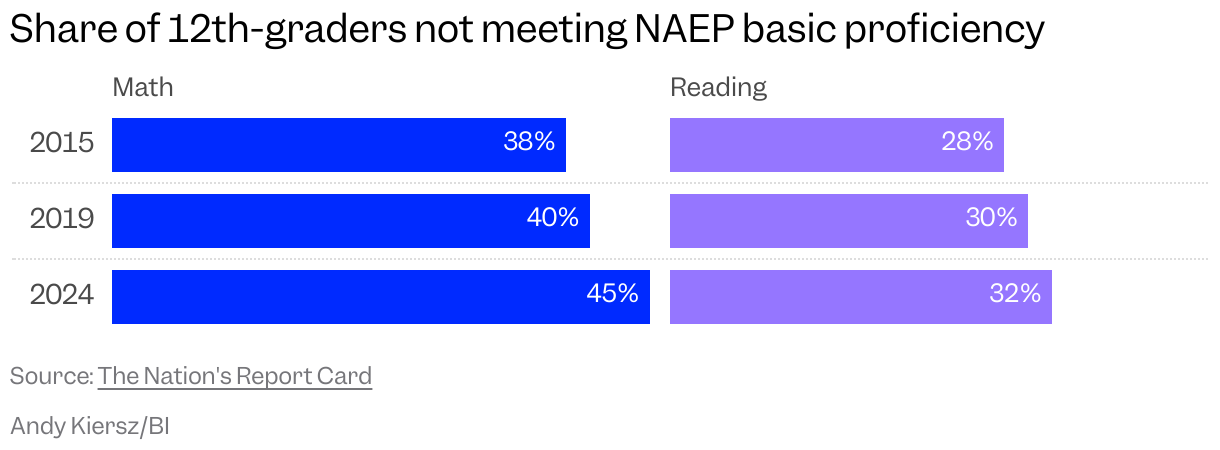
Specifically, the average math score for 12th grade in 2024 was the lowest it had been since the assessment began in 2005; 45% of them performed below the NAEP basic achievement level. For reading scores, just 35% of 12th-graders were at or above NAEP's proficiency level, and their average score was 10 points lower than when the reading assessment was first administered in 1992.

"These results are sobering," Matthew Soldner, acting commissioner of the National Center for Education Statistics, said in a statement. "The drop in overall scores coincides with significant declines in achievement among our lowest-performing students, continuing a downward trend that began even before the COVID-19 pandemic."

According to the assessment guidelines, if a high school senior meets NAEP's proficient level, they can likely connect key details across texts and use those details to draw conclusions about an author's tone and purpose. The latest scores indicate that most students do not have those reading skills.

These scores partly demonstrate the impact the pandemic had on student learning; in addition to the math and reading scores, NAEP also found that 31% of 12th-graders reported missing three or more days of school in the previous month in 2024, up from 26% in 2019.

Reading scores were already declining before the pandemic

Business Insider previously reported on the reading literacy crisis , partly spurred by the introduction of technology and the increasing reliance on screens instead of books.

Inconsistent reading instruction also played a role — while some states required teachers to use evidence-based practices for reading curriculum, others were using methods that were not proven to help with reading literacy.

These scores also come as the Trump administration continues to dismantle the Department of Education. The Supreme Court in June allowed the department to move forward with firing half of its staff, and just a handful of employees now remain at the National Center for Education Statistics, which collects data on student achievement.

Linda McMahon, Trump's education secretary, previously said that the cuts were made to promote efficiency and streamline data collection. The department also canceled a series of state-level NAEP assessments, including math and reading for 12th-graders, through 2032.

Some lawmakers raised the alarm on the latest results. Sen. Bill Cassidy, chair of the Senate education committee, said in a statement that "we are at risk of having an entire generation of children fail to become productive adults if classroom proficiency does not improve."

McMahon said the NAEP results confirm the "devastating trend" that kids are testing at historic lows from K-12.

"If America is going to remain globally competitive, students must be able to read proficiently, think critically, and graduate equipped to solve complex problems," McMahon said. "We owe it to them to do better."

Have a story to share? Reach out to this reporter at asheffey@businessinsider.com.

Read the original article on Business Insider


from Business Insider https://ift.tt/WF0PquY

Massive AI salaries and RTO are fueling a real estate boom in San Francisco: 'It's going to rain money'

A row of houses in San Francisco with a red For Sale sign in the foreground.
TK
  • Prices and rents across the San Francisco Bay Area are climbing thanks to an injection of AI cash.
  • "It's going to rain money in SF," one real estate agent said of OpenAI's employee stock sale.
  • AI workers are more cautious homebuyers than in past tech booms, real estate agents said.

The AI boom has lit a fuse under San Francisco's housing market, with prices and rents inflamed by a tech workforce increasingly returning to the office, and as the AI talent wars push salaries to dizzying highs.

Tech workers are flocking to the Bay Area to work at OpenAI, Anthropic, and Nvidia after the region was dealt a massive blow during the COVID-19 pandemic. Real estate agents say RTO is fueling the resurgence, with AI being particularly synonymous with in-person work and hardcore culture. What's more, tech workers, especially those working in AI, are commanding massive salaries, including multimillion-dollar compensation packages.

The salary needed to afford a home in the San Jose metro area — which encompasses Silicon Valley and the headquarters for Meta, Google, and Nvidia — crossed the $400,000 threshold for the first time in April 2024, said Daryl Fairweather, Redfin's chief economist — "an inconceivable amount of money unless you work in AI, and those salaries are probably more common." This makes it the most expensive metro area in the US. Home prices in the San Jose metro area are up 3% year-over-year, according to Redfin.

While big AI companies like OpenAI and Anthropic aren't public, employees can tap equity during stock sales on the private market.

One former OpenAI employee, who requested anonymity to speak about personal matters, told Business Insider they purchased a home in San Francisco during the company's last tender and knew of at least four others who did the same.

"It's definitely the popular move, and people are talking about it again," they said.

The luxury housing market in San Francisco is also setting records. More homes sold above $20 million in the city last year than ever before, according to Sotheby's 2025 Mid-Year Luxury Outlook report, which its international realty chief marketing officer, A. Bradley Nelson, attributed largely to AI's rise.

Another Bay Area county, San Mateo County, nestled between San Francisco and Silicon Valley, is seeing record prices for single-family homes — $2.6 million on average this year, according to MLS data. This boom is fueled by both the rise of AI and the strength of the stock market, said Raziel Ungar, a San Mateo County real estate agent who has worked with Big Tech buyers working at Oracle, Google, and Apple.

"There's been so much wealth that's been created in the last few years, in particular in the Valley, that it's pushed our prices higher," Ungar said.

AI workers adapt to newfound wealth

San Francisco real estate agent Ruth Krishnan has worked with several OpenAI employees who have cashed out during tender offers to make down payments on homes, she said.

Krishnan likened the current "level of frenzy" to the period before Facebook's IPO in 2012, with homebuying anticipation fueling rapid transactions and swaths of competitive offers on each property.

With news of OpenAI's latest $10.3 billion secondary share sale, "it's going to rain money in SF," she said.

AI workers are quickly adapting to newfound wealth. A second former OpenAI employee said that when they first moved to San Francisco, they lived in a group house and paid roughly $1,200 a month in rent. Now, former colleagues frequent Michelin-starred restaurants and wear luxury goods.

"They have massive bag collections, they have upgraded their houses, and everything," the second former employee said. "It feels more like a normal tech company or even kind of like finance in some ways."

The rental market is rocketing

The rental market is also rocketing. Rents across the San Francisco metro area are up about 5% since last year — double the pace of national growth, a Zillow representative told Business Insider.

Apartment hunters are handing out "tenant résumés" at packed showings, making offers site unseen, offering several months of rent in advance, or coming in at thousands of dollars over the asking price, The San Francisco Standard previously reported.

In terms of specific San Francisco neighborhoods, Mission Bay is central to AI activity, Krishnan said, while the Hayes Valley neighborhood has been dubbed "Cerebral Valley."

Other desirable neighborhoods for those in the field include South Beach, Dogpatch, Potrero Hill, the Mission, Noe Valley, and Bernal Heights, Krishnan said.

More cautious buyers than in past tech booms

Despite their eye-popping salaries, the average AI homebuyer tends to be more pragmatic, real estate agents said.

They're "data-driven and decisive," said San Francisco real estate agent Danielle Lazier, adding that many clients "model payments, taxes, and micro-market evaluations with large language models before touring."

While the single-family home market is "on fire" and condos are "perking up," Lazier said a full pre-COVID recovery hasn't yet been attained.

Krishnan agreed that buyers in AI aren't "going crazy," adding that a typical purchase ranges from $2 million to $4 million — still a relatively staggering sum. The AI wave is nascent, and while many of her clients are young, they're aware of past tech busts, she said.

"They're being very cautious about what if this doesn't last forever," she said.

"They've heard of people who thought that they had all this money that then disappeared, and it seems to be top of mind for them, actually. So they're not overspending. They're cautiously spending."

Read the original article on Business Insider


from Business Insider https://ift.tt/jzpt0QR