Saturday, January 15, 2022

We tried to get free at-home COVID tests on the first day they became available. We were not successful.

reporters with at home test kits that were not immediately reimbursed by insurance
"Save your receipt" is what the cashiers told us at Walgreens. Some insurance companies are partnering with "preferred" pharmacies to offer home test kits at no upfront cost.
  • On Saturday, insurance companies were slated to start reimbursing at-home COVID-19 test kits — 8 tests per customer per month.
  • We checked out how it worked in California and New York and found many pharmacies didn't have any tests in stock.
  • The 2 stores that had tests didn't reimburse on the spot.

On Saturday, the US government began requiring private insurance companies to cover the cost of 8 home COVID-19 test kits per person per month. 

But that doesn't mean you can necessarily pop down to your nearest pharmacy and get 8 free tests to go.

We visited two pharmacies in New York and four in California on Saturday, and got different results at every place we went.

We were unable to get any tests paid for upfront through our insurer, and ended up having to submit requests for reimbursement through the mail. 

"Preferred" pharmacies aren't supposed to charge upfront, but we were out of luck 

When the Department of Health and Human Services announced the new requirement on Monday, it stressed that the new rule "incentivizes insurers to cover these costs up front," so that consumers don't have to pay for their tests out of pocket. Instead, insurers are setting up some programs that allow people to get the over-the-counter tests directly through "preferred" pharmacies "with no out-of-pocket costs."

"Most consumers with private health coverage can go online or to a pharmacy or store, buy a test, and either get it paid for up front by their health plan, or get reimbursed for the cost by submitting a claim to their plan," HHS said. 

The reality is that insurance companies may only have one "preferred" retailer at which you can receive free test kits with no out of pocket costs. Or, they may have none. 

For example, United Healthcare, the largest insurance company in the US, only reimburses tests upfront at Walmart Pharmacies. If you don't live near a Walmart Pharmacy, or decide to shop somewhere else, you have to pay for the test kit upfront, save your receipt, and submit it for reimbursement. The maximum allowed reimbursement is $12 per test ($24 for a 2-pack). 

But at two Walmart Pharmacies in California, the pharmacists weren't aware that a reimbursement program for United-insured customers existed. One of the pharmacists said the store's COVID-19 rapid tests had been sold out for weeks. The other store hadn't received any rapid test shipments in days. 

Anthem, another large US insurer, is allowing some members to order tests kits directly through their website, at no cost. But as for the federal reimbursement program, the company says its still "finalizing" the plans.

Save your receipt

photo of abbot binax now test kit with receipt on top. insurance is supposed to reimburse 8 tests a month, but it appears not to be an on-the-spot system.
Insurance is supposed to reimburse 8 tests a month starting Saturday, but it appears not to be an on-the-spot system.

Just one pharmacy that Insider visited on Saturday had heard of the federal reimbursement program.

At a local, independent pharmacy in Brooklyn, the pharmacist said he was aware that the program was starting today, but had recieved no guidance or information about it, and was planning to inquire with insurance companies next week as to whether any might cover the tests upfront for their members at his store.

A Duane Reade/Walgreens in New York recommended saving your receipt and submitting it to insurance.

At a Walgreens in Orange County, California, the pharmacist recommended calling your insurance company. (The pharmacy had posted a sign saying at-home COVID-19 tests were out-of-stock, but a worker managed to find a handful of FlowFlex tests behind the counter. The tests are in such short supply that customers were limited to two per person.)

An employee at a CVS in Orange County wasn't sure how to reimburse at-home tests, either. The store had a supply of 300 rapids tests as of 8 a.m. local time this morning, she said, but the tests had sold out within the hour. The store also hadn't received a shipment of Abbott's BinaxNOW, one of the most widely available rapid tests in the US, in roughly a month, the employee said. 

The real way to get a free test kit

walmart covid test
The reporter at a Walmart in Orange County, California.

If you don't live near a "preferred" pharmacy and don't want to pay out of pocket for a test kit, there is a federal website coming online next Wednesday, COVIDtest.gov, which will send people free test kits through the mail.

Households will be able to order up to 4 COVID-19 tests kits each, but beware they may take 1-2 weeks to be delivered, so it's best to order ahead.  

Read the original article on Business Insider


from Business Insider https://ift.tt/33E99bU

Friday, January 14, 2022

CDC: Ditch your cloth mask and get a NIOSH-approved N95 for the best protection against Omicron

A medical worker fit tests an N95 mask to a hospital worker at the US Department of Veterans Affairs Boston in West Roxbury, Massachusetts on January 11, 2022.
Respirators, when "worn properly" protect better than cloth or surgical masks, the CDC said.
  • The CDC is urging Americans to up their mask game in the face of the Omicron variant.
  • The agency says the best mask for you is the one that fits you well (covering both nose and mouth) and that you will wear consistently.
  • This is the first time the CDC's said it may be best for everyone — even non-medical workers — to use NIOSH-approved N95s.

The Centers for Disease Control and Prevention is urging Americans to up their mask game, in the face of the highly-transmissible Omicron variant.

The public health agency still asserts that "any mask is better than no mask," and the best mask is one that fits you well, and you'll wear consistently.

But, in the face of a more infectious coronavirus variant, the CDC released new mask guidance on Friday evening stressing it's perfectly OK, and in fact preferable now, to use National Institute for Occupational Safety and Health (NIOSH)-approved, N95 masks to protect yourself from the virus, even if you're not a healthcare worker. 

"While all masks and respirators provide some level of protection, properly fitted respirators provide the highest level of protection," the new guidance, issued Friday night, read. 

High-quality, well-fitted, medical masks stop the spread of the virus near-perfectly, making them an important tool in preventing infections, deaths, and also the rise of new variants. N95s, when manufactured and worn correctly, filter at least 95% of particles in the air. The Environmental Protection Agency rates their fitted filtration efficiency at 98.4%.

Loose cloth masks offer the worst protection, while well-fitting N95s are best 

surgical mask dangling from rearview mirror
"N95s offer the highest level of protection" against the coronavirus, the CDC said on Friday.

The new guidance marks a major shift in mask advice for the general public. Since the early days of the pandemic, the CDC had encouraged laypeople who were not on the frontlines of the pandemic response to abstain from using N95 respirators, asking that those highly effective masks be saved for medical personnel. 

But now that many high-quality masks made from medical-grade materials are widely available to consumers, there's no reason for people to feel bad about using them to protect themselves and their families from getting sick.

"Respirators are made to protect you by filtering the air and fitting closely on the face to filter out particles, including the virus that causes COVID-19," the CDC's new guidance explains, providing a hierarchical framework for thinking about how much protection your mask provides.

Here is the 4-tiered system the agency uses to explain how to think about how good your mask is: 

  • Loosely woven cloth products provide the least protection
  • Layered finely woven products offer more protection, 
  • Well-fitting disposable surgical masks and KN95s offer even more protection,
  • Well-fitting NIOSH-approved respirators (including N95s) offer the highest level of protection.
  • The CDC still says that specially labeled surgical N95 respirators — a special subtype of N95 that provides additional protection against biohazards like blood "should be reserved for use by healthcare personnel."

"Whatever product you choose, it should provide a good fit (i.e., fitting closely on the face without any gaps along the edges or around the nose) and be comfortable enough when worn properly (covering your nose and mouth) so that you can keep it on when you need to," the CDC also said in the new guidance.

Beware of counterfeit products

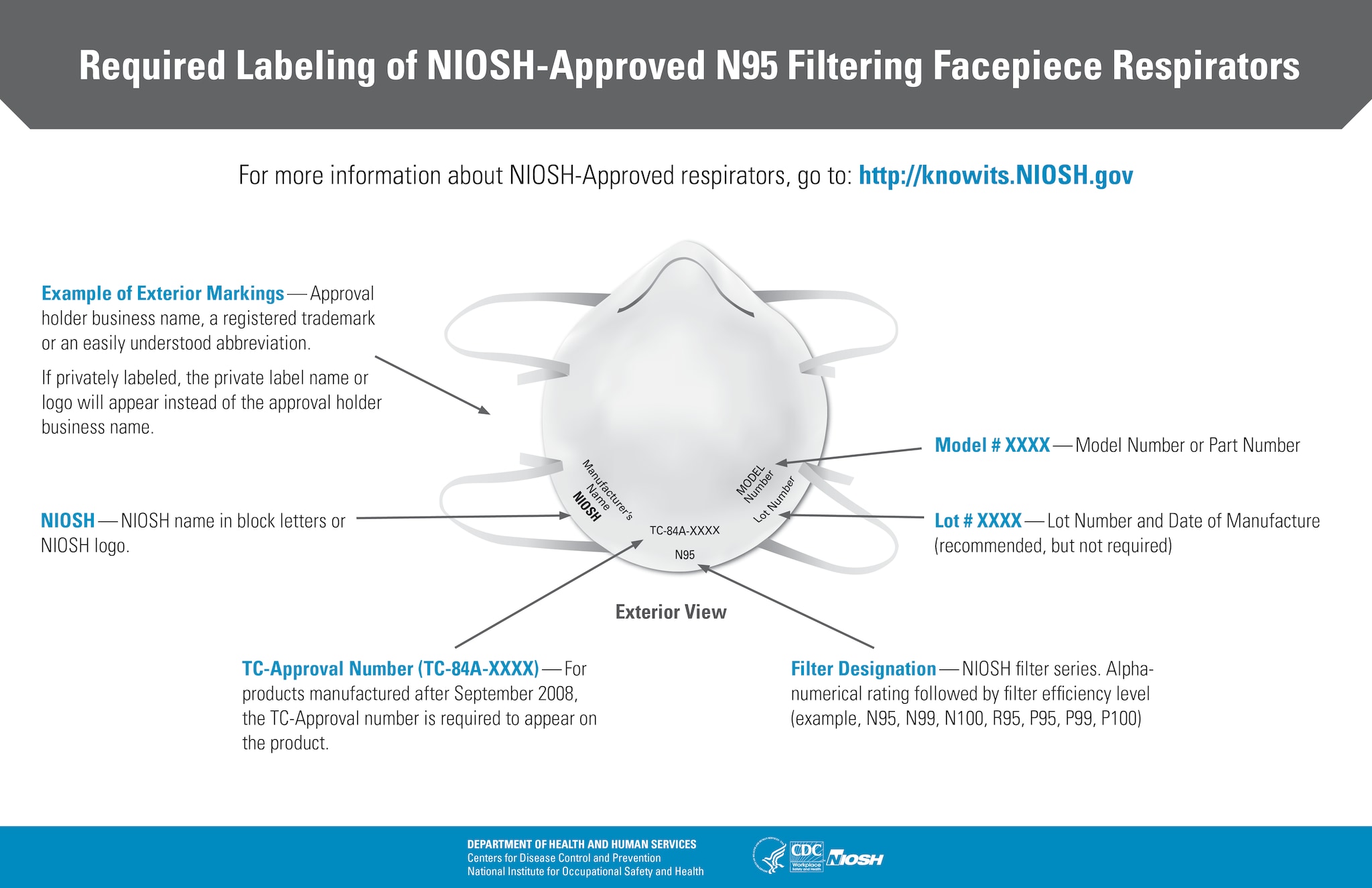
The agency warned against masks proclaiming to be NIOSH-approved, when they are not. The CDC maintains a list of NIOSH-approved respirators that is updated weekly.

"CDC still continues to recommend that any mask is better than no mask," CDC Director Rochelle Walensky told reporters on Wednesday, when asked during a briefing about updating mask guidance. "We do encourage all Americans to wear a well-fitting mask to protect themselves and prevent the spread of COVID-19, and that recommendation is not going to change."

When an N95 is essential

The new guidance stresses that certain situations merit a high level of protection against the virus. N95s are an especially smart idea if you're:

  • Caring for someone who has COVID-19
  • At increased risk for severe illness (like immunocompromised people, or older adults)
  • Working at a job where you interact the public, "especially when not everyone is consistently wearing a mask," the CDC said. "For example, bus drivers and grocery store workers."
  • Riding public transportation
  • In a crowded indoor or outdoor public setting, where social distancing is limited
  • Not up to date on COVID-19 vaccinations

For kids, this isn't so simple

The CDC maintains that everyone 2 years or older should mask up when indoors, in areas of high transmission, but finding good masks that fit tiny faces can be a challenge, since there are no industrial respirator standards for kids.

Mechanical engineer Aaron Collins, aka the "Mask Nerd" has created a spreadsheet to help parents choose the best available well-fitting masks for their children.

Read the original article on Business Insider


from Business Insider https://ift.tt/3K8VkDr

A mask expert who's also a parent shares what masks he buys for his son to reduce his risk of COVID-19

KF94 mask white on blue background
Close-up of KF94 mask.
  • Aaron Collins goes by the "Mask Nerd" now that his unofficial job is reviewing face masks in his bathroom.
  • Collins, an aerosol expert, compiled a list of the best child-sized masks to protect against COVID-19.
  • His son's favorite mask is a KF94 made in South Korea, which is effective and comfortable.

Thousands of parents turn to Aaron Collins for advice on which face masks they should buy for their kids.

Since January 2021, Collins has put his background in aerosol science to use in testing how well various face masks block coronavirus-sized particles. He started trying out adult masks, then child-sized options for his five-year-old son.

A mechanical engineer by trade, Collins has access to scientific equipment that can turn his home bathroom into a makeshift laboratory. He started posting his findings on YouTube and soon began answering questions posed by his more than 21,000 subscribers.

The question that parents ask the most often is which mask his young son — dubbed "Mask Nerd Jr." — wears to school, Collin said in an August video about masks for kids.

He added that he can't guarantee that a mask he reviews will properly fit a viewer's child, since his own test pool is quite limited. In general, he recommends buying a variety of masks in similar sizes to compare and find the best fit for your child.

Collins' son wears a Korean face mask that may fit 4-to-9-year-olds

The mini mask nerd loves his KF94, a South Korean standard that comes in sizes to fit all ages. Collins said his son's favorite is the Blue (industry brand) "tiger mask," a plain white boat-style mask that has a tiger superhero on the packaging.

The boat or duckbill style, which has a flat panel in front instead of a seam down the middle, can fit the majority of faces if sized properly. Collins' son wears a size small, which is advertised to fit kids between the ages of four and nine.

He also likes a similar style "ducky" mask by Bluna, another Korean brand. Both masks are currently sold out at Collins' recommended retailers, which include Korean beauty stores that get their products imported. 

A couple of those stores — Be Healthy USA for the tiger mask and KollecteUSA for the ducky — have notices on their websites saying they'll resume shipping the sold-out masks January 17.

More high-quality mask options for kids of all ages can be found on a spreadsheet where Collins compiled the best ones he tested, along with links for where to buy them.

The US lacks a mask standard that applies to children

Without a general population mask standard in the US, finding kid-sized masks is hard.

The numbers and letters we've come to associate with masks — N95, KN95, KF94, and so on — reflect a test standard put in place by the manufacturing country. But in the US, that standard only applies to adults.

​​The National Institute for Occupational Safety and Health (NIOSH) has been responsible for workplace safety in the US for more than 50 years. Part of that job includes approving N95 respirators, which were originally designed for industrial use.

Until COVID, there wasn't much demand for kid-sized respirators in the US. Small children shouldn't be working, especially not in settings where PPE is needed, so NIOSH has no stake in the issue, Collins said.

But that leaves a big gap in the US mask supply, which is why experts like Collins often look abroad for tiny, top-notch masks.

Read the original article on Business Insider


from Business Insider https://ift.tt/3ntsEuT

US stocks whiplashed as banks drop on earnings results and bond yields surge

US stock trader Wall Street stock exchange woman
Traders have been cheered by earnings but are still concerned about inflation.
  • US stocks experienced a volatile trading session on Friday as bond yields surged and banks reported earnings results.
  • A big miss in December retail sales initially sent the Nasdaq lower before recovering.
  • US retail sales dropped 1.9% in December from the prior month, while economists expected a drop of only 0.1%.
  • Sign up here for our daily newsletter, 10 Things Before the Opening Bell.

December retail sales data, a surge in bond yields, and earnings results from banks sent mixed messages to investors and led to a choppy day of trades on Friday.

US retail sales dropped 1.9% in December from the prior month, well below economists' expectations for a decline of only 0.1%. The weak results follow November's print of a 0.2% gain in sales. The weak sales last month came amid the Omicron surge, rising inflation, and an earlier-than-usual holiday shopping season due to logistical concerns.

Meanwhile, the 10-Year US Treasury yield surged from 1.70% to 1.78% on Friday, but tech stocks that have typically been hurt by a rise in yields led the market higher throughout the day.

Here's where US indexes stood at the 4:00 p.m. ET close on Friday:

Banks kicked off earnings season on Friday, resulting in a 6% and 2% stock price drops for JPMorgan, and Citigroup, respectively. Wells Fargo bucked the trend and jumped 3% on Friday after it reported better-than-expected earnings results. 

The Supreme Court's decision to strike down President Biden's vaccine mandate for private employers led to a continued decline in COVID-19 vaccine makers Moderna and Novavax.

The bad news keeps rolling in for Peloton, which fell 4% on Friday after it was kicked out of the Nasdaq 100 Index just one year after its inclusion. The connected-fitness company has seen its stock fall 81% from its record high.

Dogecoin prices surged about 11% on Friday after Tesla CEO Elon Musk said the electric vehicle manufacturer would accept the meme-inspired cryptocurrency as a form of payment for certain merchandise.

Rio de Janeiro's mayor is following the lead of Miami's bitcoin-loving Francisco Suarez and will invest 1% of the city's reserves in the cryptocurrency.

West Texas Intermediate crude oil rose as much as 2.56% to $84.22 per barrel. Brent crude, oil's international benchmark, jumped as much as 2.33% to $86.44 per barrel.

Gold fell as much as 0.25% to $1,816.80 per ounce. The yield on the 10-year Treasury rose 8 basis points to 1.78%.

Read the original article on Business Insider


from Business Insider https://ift.tt/33DD2sT

A future mono vaccine may have a shot at defeating multiple sclerosis, a new study suggests

EBV particles in a cell are seen using electronic microscopy.
Particles of the mononucleosis virus (dark circles) inside a cell.
  • A study provides the strongest evidence to date suggesting the Epstein-Barr virus may lead to multiple sclerosis. 
  • Scientists disagree about whether EBV definitively causes MS.
  • Experts hope a vaccine may one day prevent some MS cases, but it may take decades.

Scientists have found the strongest evidence to date that an infection from the Epstein-Barr virus could significantly increase the risk of developing multiple sclerosis, a degenerative disease, new research suggests.

"Our data strongly suggest EBV is the leading cause of MS," Dr. Kjetil Bjornevik, a research scientist at Harvard T.H. Chan School of Public Health and lead author of the study, which was published in the journal Science on Thursday, told STAT News.

The findings offer hope that a vaccine or early treatment of the virus could one day help prevent multiple sclerosis, Alberto Ascherio, an author of the study and epidemiology professor at the Harvard T.H. Chan School of Public Health, told Insider.

But experts unaffiliated with the study say there's still uncertainty about whether the virus causes MS. 

The study suggests a much higher MS risk after infection

Multiple sclerosis, a progressive disease that affects the brain and spinal cord, is caused by inflammation that attacks myelin, the fatty tissue surrounding the nerves, according to the National Institutes of Health. In 2020, there were 2.8 million people living with multiple sclerosis worldwide.

When myelin degrades, it's more difficult for the nerves to send messages to the brain, causing blurred vision, weak limbs, tingling sensations, unsteadiness, and fatigue, according to the Multiple Sclerosis International Federation. In advanced cases, patients can have muscle weakness in their arms and legs, making it difficult to walk or stand.

To determine the link between an EBV infection and MS, scientists analyzed samples from the Department of Defense Serum Repository, a collection of more than 60 million blood samples taken from more than 10 million active and reserve duty members every few years.

The scientists compared blood samples of 1,566 service members who didn't develop MS to samples from 801 service members who received an MS diagnosis during the course of the study. Of those individuals, 107 members of the control group and 35 members of the group that subsequently developed MS started off without an EBV infection.

By the end of the study, 34 of the 35 people who developed MS had been infected with EBV at some point during the study. In these cases, the infection always preceded the diagnosis.

In other words, all but one person in the study who developed MS had a previous EBV infection — and having that infection increased the likelihood of getting MS later in life by 32-fold in the study, the scientists found. 

Jury's still out on whether EBV definitively causes MS, some experts say  

It's difficult to definitively prove that EBV, which is also the virus behind mononucleosis, causes MS.

Although it's the most authoritative study to date, the way the study is designed means scientists can't know with absolute certainty that the virus causes the disease, Alan Thompson, dean of the Faculty of Brain Sciences from University College London and a peer reviewer on the new paper, told Insider.

It's possible that the virus does cause the disease, Thompson added, scientists just aren't 100% sure.

"We do need to be a little cautious about getting too excited," Catherine Godbold, research communications manager for the MS Society, a charity in the UK, said of the study results.

The gold standard would be to do a randomized controlled trial, but that's impractical as well as unethical, Godbold explained, because it would involve infecting half of study participants with EBV. The current study design is the next best thing, she added.

While the study did not directly investigate how EBV could potentially cause multiple sclerosis, previous research may provide clues. 

Some research groups have suggested that the virus carried a molecule at its surface that looks like myelin, confusing immune system, which sees it as a foreign invader to attack, causing inflammation, according to STAT News. Different researchers theorize that immune cells, called B cells, may turn against the body when infected by EBV, STAT reported. 

A mock up of an EBV test shows a person holding a test tube with a check next to the + sign next to the work EBV.
Scientists disagree about whether the Epstein-Barr virus directly causes multiple sclerosis.

A vaccine offers hope, but may take decades

While there's currently no treatment or vaccine against EBV, the pharmaceutical company Moderna is in the early stages of developing an EBV vaccine, using similar technology to current mRNA COVID-19 vaccines. 

Using existing technology may quicken the availability of EBV vaccines, by shortening the timeline from decades to years, Thompson said. 

Most people catch EBV during their lifetimes, usually during childhood, but the vast majority don't develop multiple sclerosis, so it's also important to figure out what other factors are at play. Genetics, vitamin D deficiency, and childhood obesity are all risk factors associated with multiple sclerosis.

Aschiero is hopeful: "If you could prevent infection, we should be able to prevent the large majority of MS cases."

Read the original article on Business Insider


from Business Insider https://ift.tt/3fGPoUd

Nancy Pelosi — under pressure — directs House to consider bigger penalties for lawmakers and aides who break a federal conflict-of-interest law

House speaker nancy pelosi
Speaker of the House Nancy Pelosi, a Democrat from California, takes questions from reporters at her weekly news conference on Capitol Hill on Thursday, Nov. 4, 2021.
  • A House panel will scrutinize congressional stock trades following Insider's 'Conflicted Congress' investigation.
  • Lawmakers may face higher fines if they report their stock trades late. 
  • The move comes after Insider revealed numerous violations and lawmakers are proposing stock bans. 

Facing withering criticism from political friends and foes alike, House Speaker Nancy Pelosi is directing a panel to consider higher fines for lawmakers and top aides who violate a law on congressional stock trading meant to combat financial conflicts of interest. 

The Democratic leader asked the Committee on House Administration to investigate how many members have broken the reporting requirements of the the 2012 Stop Trading on Congressional Knowledge Act, also known as the STOCK Act.

At least 54 members of Congress and 182 of their top aides have violated the STOCK Act's disclosure provisions, according to Insider's "Conflicted Congress" investigation, which published in December.

Drew Hammill, Pelosi's deputy chief of staff, told Insider that the Speaker asked the panel to look into "the possibility of stiffening penalties," and confirmed it would extend to senior staff. 

"The speaker believes that sunlight is the best disinfectant and has asked Committee on House Administration Chair Zoe Lofgren to examine the issue of Members' unacceptable noncompliance with the reporting requirements in the STOCK Act," he said. The panel is responsible for setting rules on lawmakers and staff, including everything from human resources directions to ethical standards.

Pelosi's actions contrast with most recent statements about members of Congress and their stock trades. Following publication of Insider's "Conflicted Congress" project, Pelosi told Insider that members of Congress should be allowed to buy and sell individual stocks. 

"We are a free-market economy. They should be able to participate in that," Pelosi said, adding that members of Congress should report their trades on time.

But while the STOCK Act requires members of Congress to publicly report their stock transactions within 30 to 45 days, depending on when they learned about a trade, dozens of Democrats and Republicans alike have recently failed to do so. Some have broken federal disclosure deadlines by months with stock trades worth into the millions of dollars.

Lawmakers who have violated the STOCK Act's disclosure provisions routinely invest in companies that vie for federal contracts and lobby the federal government, sometimes spending millions of dollars annually to do so.

"Conflicted Congress" also revealed numerous, recent examples of potential conflicts: House Armed Services Committee members trading defense contractor stocks, lawmakers responsible for health policy buying shares of COVID-19 vaccine manufacturers, environmentally minded congressional members investing in oil companies.

Pelosi does not personally trade stocks, but her husband, Paul Pelosi, has millions of dollars worth of stock investments that the speaker must by law disclose. 

Insider also contacted Senate Majority Leader Chuck Schumer's office and the Senate Rules Committee to ask whether the Senate might undertake a similar review, but did not immediately receive a response. On Tuesday, Schumer dodged a question about whether he supported a stock trading ban for lawmakers, but told Insider "I don't own any stocks, and I think that's the right thing to do."

Close up images of Rep. Kevin McCarthy and Rep. Alexandria Ocasio-Cortez side by side.
Republican House Minority Leader Kevin McCarthy of California and Democratic Rep. Alexandria Ocasio-Cortez of New York are among a growing, bipartisan coalition of lawmakers who have expressed support for a ban on members of Congress trading individual stocks.

Minimal consequences

Insider's "Conflicted Congress" investigation found that few face consequences for violating the law, including cases in which they reported millions of dollars in trades months or even years late.

Scofflaws are supposed to pay a late fee of $200 the first time they file a report about their stock trades late, and increasingly higher fines are supposed to follow if they continue to be late — potentially costing tens of thousands of dollars in extreme cases. But that rarely happens.

Pelosi's latest actions come as lawmakers on both sides of the aisle have in recent days proposed a slew of similar bills to ban stock trading, including a pair of competing proposals unveiled on Wednesday by Sen. Jon Ossoff, a Democrat of Georgia, and Sen. Josh Hawley, a Republican of Missouri. 

House Minority Leader Kevin McCarthy of California, who is poised to become the new speaker if Republicans win back the House after the 2022 elections, told Punchbowl News this week he supports restrictions on members of Congress buying and selling individual stocks. Democratic Rep. Alexandria Ocasio-Cortez and Democratic Sens. Elizabeth Warren of Massachusetts, Jeff Merkley of Oregon and Mark Warner of Virginia have also said they want tough restrictions on lawmakers' stock trades.

Pelosi's decision also arrives as the White House on Friday opened the door to a potential ban on members of Congress trading individual stocks. 

Meanwhile, Rep. Angie Craig, a two-term Democrat from Minnesota, is preparing to next week introduce a resolution banning members of the US House from owning "common stock of any individual public corporation."

Unlike the several other bills lawmakers are introducing to squelch stock trade activity among members of Congress, Craig's resolution, if passed, wouldn't be a law. Instead, it'd be a House rule that only applied to House members and not subject to a vote in the US Senate or the signature of President Joe Biden.

Why is Craig willing to defy Pelosi on this matter and potentially invite political blowback from the speaker?

"I just fundamentally disagree with her on this topic … I wish the speaker had a different point of view," Craig told Insider on Friday. "If the American people can't believe that we're here just to serve them, not to pad our own portfolios, then how can they trust we're doing what's in our best interest?

"I want to start the conversation about why my leadership wants to block this legislation," Craig said, adding that she will "working across the aisle to see what kind of support we can build."

Craig recalled once participating in a House Subcommittee on Aviation hearing about Boeing, the aviation and defense contracting giant.

"I literally sat there that one day and said to myself, 'My God, if I wanted to short Boeing today, and make a little money — this is the most ridiculous thing in the world that members of Congress can trade individual stocks," she said. "We often get information before the general public."

Read the original article on Business Insider


from Business Insider https://ift.tt/3I7yslW

The Biden administration is buying 500 million rapid COVID-19 test kits to give Americans for free — here's how to get one

A resident displays an at-home rapid COVID-19 test kit in Philadelphia, Monday, Dec. 20, 2021
  • The Biden administration is buying 500 million at-home COVID test kits to give Americans for free.
  • Americans will be able to order test kits to be delivered to their homes starting January 19. 
  • The administration will also require insurers to reimburse rapid test kits starting on January 15.

The Biden administration is purchasing 500 million at home, rapid COVID-19 tests to distribute to Americans at no cost in response to a rise in cases spurred in part by the highly contagious Omicron variant.

The website where Americans will be able to order tests, covidtests.gov, is set to go live on Wednesday, January 19. 

Here's what we know about how and when Americans can get a free test kit: 

When can I get a free test? 

The Biden administration will start making test kits available at no cast at covidtests.gov starting on January 19, 2022. Test kits are expected to ship in seven to 12 days, the White House said. 

Eight different brands of at-home rapid COVID tests are currently authorized for use by the Food & Drug Administration. The White House has officially reached a deal with the US Postal Service to distribute the 500 million tests, and also plans to order an additional 500 million tests on top of its initial order. 

Will the government automatically send free rapid test kits to all American households? 

No. Americans that want free tests will need to order them. The free test kits will be limited to only four per address, the White House said, with high-risk communities and those hardest-hit by the Omicron variant prioritized for access to tests. 

Is my state or city giving out free COVID test kits?

Depending on where you live, yes!

Some major cities, like New York City, Washington, DC, and Philadelphia, and states including Massachusetts, New Jersey, New Hampshire, Washington, Iowa, Ohio, Maryland, and Colorado are offering free COVID-19 test kits to some or all residents, according to NPR. 

Can I get the cost of a COVID-19 rapid test reimbursed by my insurance in the meantime?

Starting on Saturday, yes.

The Biden administration announced in early December of 2021 that they would also issue a mandate requiring private insurers to fully reimburse the costs of rapid, at-home COVID-19 test kits purchased over-the-counter. The reimbursement requirement will officially go into effect on January 15.

The reimbursement mandate, however, won't be retroactive for past purchases, meaning that the millions of Americans who shelled out money to buy rapid test kits in preparation for the holidays will have to shoulder those costs out of pocket. 

One state, Vermont, has a state-level mandate requiring all insurers who operate in the state to reimburse all over-the-counter.

But while most major private insurers cover the costs of COVID-19 tests conducted in a medical setting or at a test site, many insurers will only reimburse over-the-counter COVID test kits that were ordered by a doctor. 

Read the original article on Business Insider


from Business Insider https://ift.tt/3H4qzgi

10 things before the opening bell

bitcoin cryptocurrency - stock illustration
Bitcoin has slumped recently.

Welcome to 10 Things Before the Opening Bell.

If this was forwarded to you, sign up here. Plus, download Insider's app for news on the go – click here for iOS and here for Android.

Programming note: There will be no newsletter on Monday, in observance of Martin Luther King Jr. Day. We'll be back in inboxes Tuesday.

Let's get into it. 


1. The crypto debate rages on in the new year. Disagreements abound as the bitcoin bear market drags on, with hot takes coming from investors, governments, and central banks. 

In one corner this week, the CFO of Robinhood said he sees no reason to put a "meaningful" amount of corporate cash into crypto. Meanwhile, Shark Tank's Kevin O'Leary compared the space to the tech firms of the 1990s, calling crypto the biggest opportunity for investors in 2022.

El Salvador faces perhaps the most immediate pressure from bitcoin's recent slump. Bloomberg estimated the country has lost upwards of $10 million on its investment in the coin. 

In the world of central bank digital currencies, a broad buy-in from the US or the UK still appears to be a long way off. A House of Lords report published Thursday said there's no convincing case for a "Britcoin," And in the US, a congressman proposed a bill to limit the Fed's ability to issue its own digital currency, while the Fed itself has been slow to publish its long-awaited report on the topic. 

Still, Fed Chair Jay Powell remarked in his confirmation hearing that a US central bank digital currency would be able to coexist with private crypto. 


2. Global stocks are sliding after hawkish Fedspeak. With big bank earnings on deck, US indexes are struggling to shake off losses. Check out the latest moves on the market.

3. Bank of America shared a list of under-owned stocks most likely to top expectations in earnings season. Rising inflation and COVID-19 cases are looming threats — but these 13 unloved stocks can bolster your portfolio. 

4. Earnings season kicks off: JPMorgan Chase, Wells Fargo, BlackRock, and Citigroup, all reporting.

5. The Fed's impending rate hikes have flipped markets upside down. Investors are completely changing their minds about what stocks to own as the easy-money era winds down. These three charts explain what's going on.

6. Elon Musk revealed Tesla is accepting dogecoin to pay for some merch. It's the only accepted currency for some items in Tesla's online store, but some believe it's a test run for more. The meme coin soared on the news.

7. China is launching a state-run NFT blockchain that is entirely separate from cryptocurrencies. After banning cryptocurrency transactions in 2021, Beijing now looks to capitalize on the NFT boom by developing and governing its own technology for non-fungible tokens. Here's the latest on China

8. Crypto exchanges FTX and Bitstamp are working to add stock trading to their US platforms. After a report from Bloomberg on the moves, Robinhood stock dropped in trading. The president of FTX.US tweeted the exchange is "hard at work on stocks."

9. A single mom quit her job after reaching financial freedom in four years. Specific investments helped her grow her savings into a $900,000 portfolio. She shared three steps every woman should take to reach earlier retirement.

10. A SPAC investor gave his top 18 picks from four blue-ribbon blank-check sponsors. The market "swings between super-hot and ice-cold sentiments," said Accelerate Fintech's Julian Klymochko. He and two other experts told Insider the trends to watch for the new year.


Compiled by Phil Rosen. Feedback? Email prosen@insider.com or tweet @philrosenn.

Sign up for more Insider newsletters here.

Read the original article on Business Insider


from Business Insider https://ift.tt/3FrCQKO